Origami Lotus Flower Instructions PDF: A Comprehensive Guide
Discover detailed PDF guides for crafting stunning origami lotus flowers! Explore step-by-step visuals, printable formats, and easy-to-follow instructions for all skill levels.
Unlock the secrets to beautiful paper blossoms with readily available online resources and tutorials, perfect for a relaxing and rewarding hobby.
Origami lotus flowers represent a captivating intersection of ancient art and serene beauty. These delicate creations, born from the simple folding of paper, have enchanted enthusiasts for generations. The lotus, deeply symbolic in many cultures – particularly in Eastern traditions – embodies purity, enlightenment, and rebirth, making origami versions particularly meaningful.
Creating an origami lotus isn’t merely about following instructions; it’s about embracing a meditative process. The repetitive folds and precise creases offer a calming experience, while the final bloom symbolizes the potential for growth and transformation. Numerous resources, including readily available PDF tutorials, cater to all skill levels, from absolute beginners to experienced origami artists.
Whether you’re seeking a relaxing hobby, a unique handmade gift, or a way to connect with a rich artistic tradition, the origami lotus flower provides a fulfilling and visually stunning outcome. PDF instructions offer the convenience of printability and portability, allowing you to practice your craft anywhere, anytime.
Why Choose Origami Lotus? (Symbolism & Popularity)
The origami lotus flower holds profound symbolic weight, particularly within Asian cultures, representing purity of heart and mind, spiritual awakening, and detachment. This symbolism contributes significantly to its enduring popularity as a subject for origami. PDF instructions make accessing this beautiful art form incredibly easy.
Beyond its spiritual connotations, the lotus’s aesthetic appeal is undeniable. Its elegant form and graceful unfolding petals are visually captivating. Origami allows you to recreate this beauty using just a single sheet of paper, offering a tangible connection to nature and artistry; The availability of detailed PDF guides ensures success for all skill levels.
Furthermore, origami is a mindful activity, promoting relaxation and focus. Creating a lotus flower can be a meditative practice, offering a respite from the stresses of daily life. The widespread availability of free and premium PDF tutorials fuels its continued growth in popularity worldwide.
Materials Needed for Origami Lotus Creation
The beauty of origami lies in its simplicity – you primarily need just one key material: square paper! However, the type of paper dramatically impacts the final result. PDF instructions often suggest specific paper weights and sizes for optimal folding. Beginners can start with standard origami paper, readily available in various colors.
For more advanced creations, consider using higher-quality paper like washi (traditional Japanese paper) or foil paper. These materials offer increased durability and a more refined aesthetic. A flat, clean work surface is also essential for precise folding. Optional tools include a bone folder for crisp creases and tweezers for intricate details.
Accessing PDF tutorials often lists these requirements upfront, ensuring you’re fully prepared. While specialized tools enhance the experience, they aren’t strictly necessary. Ultimately, a willingness to learn and a square sheet of paper are all you truly need to begin your origami lotus journey!
Choosing the Right Paper for Lotus Origami
Selecting the appropriate paper is crucial for a successful origami lotus flower. PDF guides frequently emphasize this point, as paper choice affects both the folding process and the final appearance. Thinner paper, around 60-80gsm, is ideal for complex models with numerous layers, allowing for easier folding and cleaner creases.
However, thicker paper, like 100gsm or higher, provides more structure and holds its shape better, particularly for larger lotus blossoms. Double-sided paper, with different colors on each side, creates a visually striking effect, highlighting petal details. Experimenting with textures, such as metallic or patterned paper, adds unique flair.
Many PDF tutorials recommend starting with 15cm x 15cm (6×6 inch) squares. Consider the complexity of the chosen PDF instruction; simpler designs tolerate a wider range of paper types. Ultimately, the best paper is one that balances foldability with structural integrity, enhancing your origami experience.

Step-by-Step Folding Instructions
Follow clear PDF diagrams to master each fold! Begin with the preliminary base, then create petal layers, inverting and repeating for a beautiful bloom.
Detailed PDFs guide you through every step.
Step 1: Creating the Preliminary Base
Embark on your origami journey by mastering the preliminary base – a fundamental fold crucial for many origami models, including the lotus flower. PDF instructions often begin here, emphasizing its importance. Start with a square sheet of paper, colored side down. Fold the paper in half diagonally, creating a crisp crease, then unfold. Repeat this fold along the other diagonal, forming an ‘X’ crease pattern.
Next, fold the paper in half horizontally, and then vertically, creating a ‘+’ crease pattern. You should now have a network of creases dividing the square into eight triangles. Carefully collapse the paper along these creases, bringing all four corners towards the center. This will naturally form a smaller square, known as the preliminary base. PDF guides provide visual aids to ensure accurate folding. This base serves as the foundation for developing the lotus petals in subsequent steps, so precision is key!
Step 2: Forming the Petal Folds (First Layer)
Building upon the preliminary base, the next stage involves creating the first layer of petal folds. PDF tutorials typically illustrate this with clear diagrams. Take one of the top flaps of the square and fold its edges towards the center line, creating a kite shape. Repeat this fold on the opposite side of the same flap.
Now, flip the entire model over and repeat the kite folds on the remaining two flaps. You should now have a diamond shape with four pointed flaps. These flaps represent the initial formation of the lotus petals. Ensure your creases are sharp and precise for a clean, defined look. PDF instructions often highlight the importance of symmetry at this stage. This first layer establishes the basic petal structure, preparing for further refinement in the following steps.
Step 3: Petal Folds (Second Layer ― Refining the Shape)
Following the initial petal folds, the second layer focuses on refining the shape and creating a more realistic lotus appearance. PDF guides demonstrate this by instructing you to unfold the kite shapes created in the previous step. Then, perform an inside reverse fold on each flap, bringing the points upwards and inwards.
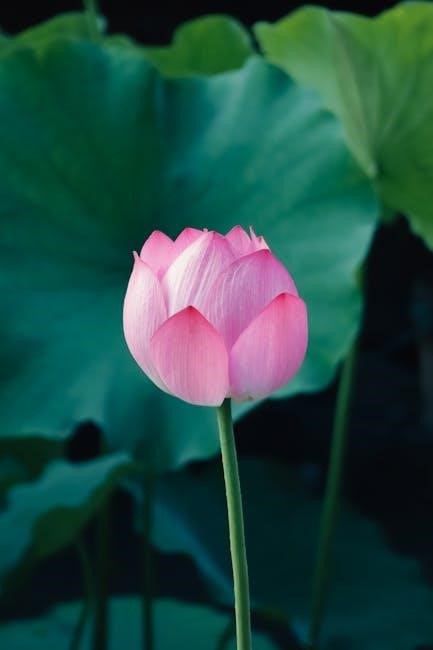
This action creates a more curved and delicate petal form. Repeat this inside reverse fold on all four flaps, ensuring consistency for a symmetrical bloom. Detailed PDF diagrams are crucial here, as the reverse folds can be tricky for beginners. Pay close attention to the angles and crease lines. This layer significantly enhances the lotus’s aesthetic, moving it closer to its final, blossoming form. Precision at this stage is key for a beautiful result.
Step 4: Inverting and Repeating Petal Folds
Now, carefully invert the entire model. PDF instructions will clearly show how to flip the origami piece without disrupting the existing folds. This reveals the underside, ready for the final set of petal formations. Repeat the inside reverse folds performed in Step 3 on this side, mirroring the process precisely.
Again, utilize the detailed diagrams within your PDF guide to ensure accurate angles and crease placement. Consistency between both sides is vital for a balanced and aesthetically pleasing lotus flower. As you complete these folds, the petals will begin to fully emerge, giving the flower its characteristic layered appearance. Gentle shaping and adjustments can further refine the bloom, bringing your origami creation to life.

Advanced Techniques & Variations
Explore complex bases like the blintz, master multi-layered blooms, and experiment with vibrant paper choices! PDF guides unlock sculptural wet-folding techniques for stunning results.
The Blintz Base: A Foundation for Lotus Flowers

Understanding the blintz base is crucial for many origami lotus flower designs, serving as a robust starting point for intricate petal formations. PDF tutorials often dedicate significant sections to mastering this foundational fold, as its accuracy directly impacts the final bloom’s aesthetic.
Essentially, the blintz base involves a series of precise folds creating a unique, layered structure. Many online resources and downloadable PDFs provide detailed diagrams and step-by-step instructions, breaking down the process into manageable stages. Beginners might find it challenging initially, but practice with a clear PDF guide will quickly build proficiency.
The blintz base allows for symmetrical petal development, essential for achieving the lotus flower’s characteristic elegance. Advanced folders often utilize variations of the blintz base to create more complex and artistic interpretations. Therefore, a solid grasp of this technique, aided by comprehensive PDF instructions, is invaluable for any aspiring origami lotus artist.
Creating Multiple Layers for a Fuller Bloom
Achieving a truly captivating origami lotus flower often involves constructing multiple layers of petals, adding depth and realism to the bloom. PDF instructions frequently showcase techniques for layering, ranging from simple additions to complex interwoven designs. These guides demonstrate how to build upon the initial folds, creating a more voluminous and visually striking flower.
The process typically involves repeating petal folds, each layer slightly offset from the previous one, mimicking the natural arrangement of lotus petals. Detailed PDFs will illustrate how to secure these layers effectively, ensuring the flower maintains its shape and integrity. Experimenting with different paper types and colors within each layer can further enhance the visual appeal.
Advanced tutorials within PDF formats may explore techniques like ‘pocket folds’ or ‘reverse folds’ to create intricate petal structures. Mastering these layering techniques, guided by clear PDF diagrams, unlocks the potential for creating breathtakingly realistic and elaborate origami lotus flowers.
Different Paper Colors & Patterns for Visual Appeal
Origami lotus flower PDF guides often highlight the transformative power of paper selection, emphasizing how color and pattern dramatically impact the final aesthetic. Beyond solid hues, explore options like dual-toned paper, where contrasting colors appear on each side, creating dynamic petal effects. PDF tutorials frequently showcase examples using traditional Japanese washi paper, known for its beautiful textures and subtle patterns.
Patterned papers, such as those with floral motifs or geometric designs, can add an extra layer of visual interest, though they may require more precise folding. PDF instructions often advise beginners to start with simpler, solid-colored papers before tackling complex patterns. Experimenting with gradients or ombre effects can also create stunning, lifelike blooms.
Detailed PDFs may include suggestions for color combinations that evoke specific moods or represent different lotus varieties. Ultimately, the choice of paper is a creative decision, guided by personal preference and the desired visual impact.
Wet-Folding Techniques for Sculptural Lotus Flowers
Advanced origami lotus flower PDF tutorials often introduce wet-folding, a technique that allows for softer curves and more sculptural forms. This involves lightly dampening the paper – typically with a sponge – before folding, making it more pliable and enabling the creation of rounded petals. PDF guides emphasize using appropriate paper types, like kozo paper, which holds its shape well when wet.
Wet-folding requires practice and a delicate touch, as over-saturation can tear the paper. Detailed PDFs provide specific instructions on the degree of dampness needed and techniques for shaping the petals while they are still moist. The result is a more organic, lifelike lotus bloom with gentle curves and a three-dimensional appearance.
Some PDFs demonstrate how to use tools like bone folders to refine the curves and create sharper creases after wet-folding. Mastering this technique elevates origami lotus flowers from flat creations to stunning sculptural art.
Finding and Utilizing PDF Instructions
Access a wealth of origami lotus flower PDF tutorials online! Enjoy the convenience of printable, portable guides for crafting beautiful paper blossoms anytime, anywhere.
Where to Download Origami Lotus Flower PDF Tutorials
Numerous websites offer free and premium origami lotus flower PDF tutorials. Begin your search on dedicated origami resource sites like Origami Club, which frequently features diagrams for various flower models, including the lotus. Explore platforms like YouTube, where many creators provide links to downloadable PDF instructions in their video descriptions.
Websites such as Gathered.how provide step-by-step guides with accompanying images, often with a downloadable PDF option. Additionally, Etsy hosts digital downloads from independent origami artists, offering unique and intricate lotus flower designs. Pinterest is a valuable source, curating links to tutorials from across the web. Remember to always check the source’s credibility and ensure the PDF is clear and easy to follow before downloading. Searching directly on Google using keywords like “origami lotus flower PDF tutorial” will yield a vast array of results.
Benefits of Using PDF Instructions (Printability, Portability)
Origami lotus flower PDF instructions offer significant advantages for enthusiasts. Primarily, PDFs are easily printable, allowing you to have a physical copy of the diagrams readily available while folding, free from screen glare or device battery concerns. This is especially helpful for complex models requiring frequent reference.
Furthermore, PDFs excel in portability. Save the file to your phone, tablet, or e-reader and practice your origami anywhere – during commutes, travel, or simply relaxing outdoors. Unlike online tutorials, PDFs don’t require an internet connection. They also eliminate distractions from other websites or apps. The fixed layout of a PDF ensures diagrams appear consistently across different devices. This format is ideal for focused learning and allows for annotation with personal notes, enhancing the learning experience.
Understanding Diagram Conventions in Origami PDFs
Origami PDF instructions rely on standardized diagram conventions for clarity. Solid lines indicate folds to be made, while dashed or dotted lines represent valley or mountain folds, respectively. Arrows show the direction of the fold, and curved arrows signify rotations. Understanding these symbols is crucial for accurate folding.
Pay attention to symbols indicating to repeat steps or flip the model over. Color-coding can differentiate layers or highlight specific folds. Many PDFs use symbols to denote “inside reverse folds” or “outside reverse folds,” which are common in lotus flower construction. Familiarize yourself with these notations before starting. Consistent diagramming ensures anyone, regardless of language, can follow the instructions. Practicing with simpler models first will build your ability to interpret these conventions, leading to success with more complex lotus designs.
Troubleshooting Common Issues with PDF Instructions
Encountering difficulties with origami PDFs is common. If diagrams are unclear, try searching for video tutorials demonstrating the same model – often, seeing the folds in motion clarifies confusion. Ensure your PDF viewer is up-to-date for optimal display. Printing issues? Check printer settings for correct scaling and paper size.
Mistakes happen! Don’t hesitate to carefully unfold and restart from a previous step. If a fold seems impossible, double-check the diagram for subtle details. Sometimes, the paper grain affects folding; experiment with different paper orientations. Online origami communities are excellent resources for seeking help and sharing troubleshooting tips. Remember, patience is key – even experienced folders face challenges. Utilizing multiple resources and a methodical approach will overcome most obstacles.
Lotus Flower Variations & Styles
Explore diverse lotus designs, from traditional to modern! Discover blooming petals, elegant buds, and detailed variations with leaves, all within PDF guides.
Unfold creativity through unique styles and techniques, enhancing your origami journey.
Traditional Lotus vs. Modern Lotus Designs
Origami lotus flower designs span a fascinating spectrum, from deeply rooted traditional methods to innovative, modern interpretations. Traditional lotus models, often found in PDF tutorials, emphasize symmetry and a classic petal arrangement, frequently utilizing the preliminary base and meticulous folding sequences. These designs prioritize elegance and a faithful representation of the flower’s natural form.
Modern designs, however, frequently push boundaries, experimenting with asymmetry, complex petal structures, and even incorporating techniques like wet-folding to achieve more sculptural and lifelike results. PDF instructions for modern variations may showcase modular designs, where multiple units are assembled, or designs that focus on capturing the dynamic process of a lotus blooming.
PDF guides often categorize designs by complexity, allowing enthusiasts to progress from simpler, traditional models to more challenging, contemporary creations. Exploring both styles provides a comprehensive understanding of origami artistry and the evolution of this beautiful craft.
Creating a Blooming Lotus (Opening Petals)
Achieving a “blooming” lotus effect in origami involves techniques to gently curve and separate the petals, simulating the flower’s natural opening process. Many PDF tutorials dedicated to this effect focus on carefully executed reverse folds and gentle shaping after the initial folding stages are complete. Wet-folding, a technique detailed in some advanced PDF guides, can be particularly effective for creating soft, organic curves.
PDF instructions often illustrate how to subtly manipulate the paper fibers, encouraging them to hold the desired shape. Key to success is avoiding harsh creases that disrupt the petal’s flow. Experimenting with different paper types – thinner papers are generally easier to shape – is also recommended.
Detailed diagrams in PDFs demonstrate precise points for applying pressure and creating the illusion of unfolding petals, transforming a closed bud into a vibrant, blossoming flower.
Lotus Bud Origami: A Simpler Variation
For beginners, the lotus bud origami offers a less complex entry point into lotus flower folding. Numerous PDF tutorials specifically cater to this simplified version, often omitting the intricate petal-shaping steps found in full-bloom models. These PDF guides typically begin with the preliminary base, similar to the full lotus, but diverge early on, focusing on maintaining a tightly closed bud shape.
The emphasis in these PDF instructions is on precise folding to create a compact, elegant bud. Diagrams clearly illustrate how to avoid over-opening the petals, preserving the bud’s characteristic form. Many tutorials highlight that this variation requires fewer advanced techniques, making it ideal for those new to origami.
Accessible PDF resources often include step-by-step photos alongside diagrams, ensuring clarity and ease of understanding for novice folders. It’s a beautiful, achievable project!

Lotus Flower with Leaves: Adding Detail
Elevate your origami lotus with realistic leaves! Many PDF tutorials demonstrate how to create accompanying foliage, enhancing the flower’s natural beauty. These guides often present separate, detailed instructions for folding individual leaves, typically utilizing basic origami folds like valley and mountain folds.
Advanced PDF resources may showcase techniques for attaching the leaves seamlessly to the lotus stem or base, creating a more integrated design. Diagrams illustrate how to shape the leaves for a lifelike appearance, including subtle curves and pointed tips. Some tutorials even offer variations in leaf size and shape for added realism.
Finding PDF instructions that combine the lotus flower and leaf folding provides a comprehensive learning experience. These resources often cater to intermediate folders, building upon foundational skills to achieve a stunning, detailed final product.

Resources and Further Learning
Explore websites, online communities, and books dedicated to origami! Discover video tutorials complementing PDF guides, deepening your lotus flower folding expertise.
Enhance skills and connect with fellow enthusiasts!
Recommended Websites for Origami Lotus Tutorials
Numerous websites offer fantastic origami lotus flower tutorials, catering to various skill levels. Origami Guide (origamiguide.com) provides clear, step-by-step instructions with accompanying diagrams, perfect for beginners. You’ll find a dedicated section specifically for lotus blossoms, detailing different variations and techniques.

Gathered (gathered.how) features a comprehensive tutorial with pictures and written instructions, making the process accessible and enjoyable. YouTube is also a treasure trove; searching “origami lotus tutorial” yields countless video demonstrations. Channels like Tadashi Mori and Jo Nakashima offer high-quality, easy-to-follow videos.
HappyFolding (happyfolding.com) is another excellent resource, offering both diagrams and videos. Don’t hesitate to explore these platforms – many provide printable PDF instructions for convenient offline access. Remember to check for user comments and feedback to gain insights and troubleshoot any challenges you might encounter during the folding process!
Online Communities and Forums for Origami Enthusiasts

Engaging with online origami communities can significantly enhance your learning experience. Reddit’s r/origami is a vibrant forum where enthusiasts share creations, ask questions, and offer guidance. You’ll find discussions specifically about lotus flower variations and troubleshooting tips.
The OrigamiUSA website (origamiusa.org) hosts a forum and provides access to a wealth of resources, including convention information and articles. Flickr groups dedicated to origami showcase stunning models and inspire creativity. Searching for “origami lotus” on Flickr reveals a diverse range of interpretations.
Facebook groups, such as “Origami Lovers,” offer a supportive environment for sharing progress and seeking assistance. These platforms are invaluable for finding PDF instructions, discovering new techniques, and connecting with fellow origami artists. Don’t be afraid to post your own creations and ask for feedback – the community is generally very welcoming and helpful!
Books Dedicated to Origami Flower Folding
Several books specialize in origami flower folding, offering detailed diagrams and instructions beyond what’s typically found in PDF tutorials. “Origami Flowers: Paper Folding for Everyone” by Ayako Rokuhara showcases a variety of floral designs, including several lotus variations, with clear, step-by-step guidance.
“Complete Origami: An A-Z of Facts and Folds” by Eric Kenneway provides a comprehensive overview of origami techniques, with a dedicated section on flowers. For more complex designs, “Origami Design Secrets” by Robert J. Lang delves into the mathematical principles behind origami, enabling you to create your own floral variations.
“Flowers Origami” by Didier Boutefeuillou is another excellent resource, featuring beautifully photographed models and detailed folding sequences. These books often include patterns suitable for printing and adapting into PDF formats for convenient access during your folding sessions.
Origami Lotus Flower Video Tutorials (Complementing PDFs)
Video tutorials offer a dynamic complement to PDF instructions, allowing you to visually follow each fold in real-time. YouTube channels like “Tadashi Mori” and “Jo Nakashima” feature numerous origami lotus flower tutorials, catering to various skill levels. These videos often demonstrate techniques difficult to grasp from diagrams alone.
Search for “origami lotus flower tutorial” to discover a wealth of options, from beginner-friendly guides to advanced techniques like wet-folding. Visual learners benefit greatly from observing the folding process, clarifying any ambiguities in PDF diagrams. Many creators also offer slowed-down sections and close-ups of intricate steps.
Combining PDF instructions with video tutorials provides a comprehensive learning experience, enhancing your understanding and improving your origami skills. Pause, rewind, and replay videos as needed, solidifying your technique and achieving a beautiful lotus bloom.